

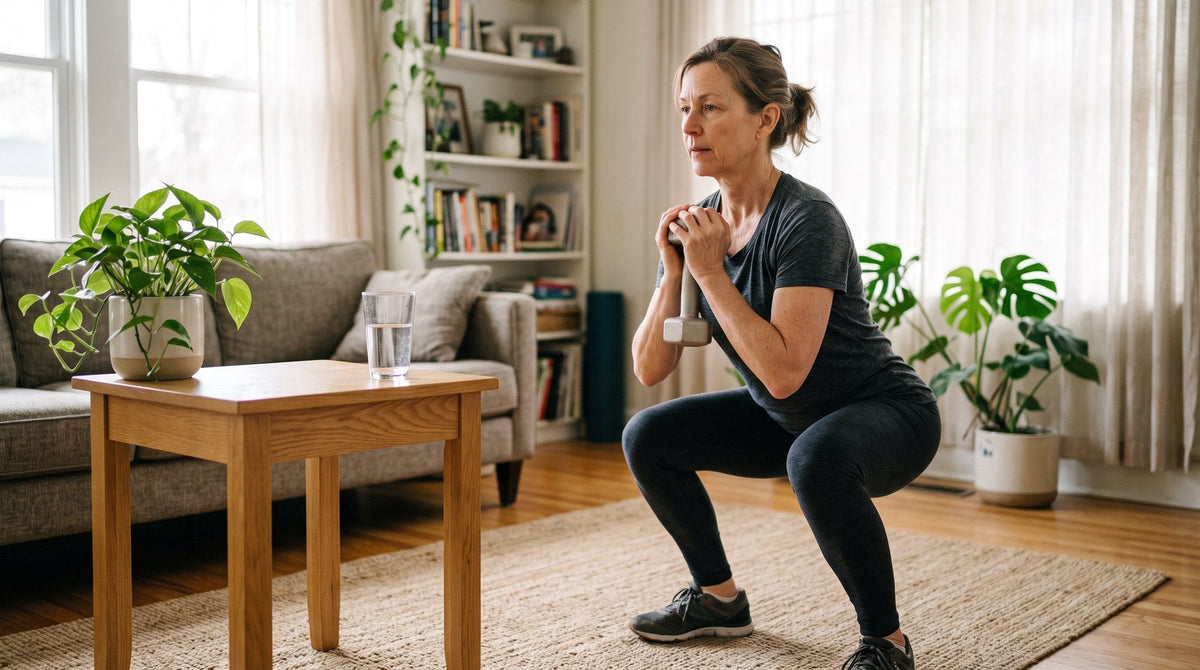
Creatine is one of the most studied supplements for strength. In adults who do resistance training, including people over 50, adding creatine monohydrate leads to modestly greater gains in strength and lean mass than training alone. The usual dose is 3–5g a day, and it has a long safety record in healthy adults.
What the research can't tell you yet is how creatine works for people taking GLP-1 medications. As of late 2026, no randomized trial has tested creatine during GLP-1 weight loss. A small pilot study is underway, so for now the case rests on indirect evidence.
Here's what the studies show, how to take creatine, and what to know about kidneys, hydration and the scale.
What Is Creatine and How Does It Work?
Creatine is a compound your body makes, mostly in the liver and kidneys, from the amino acids arginine, glycine and methionine. You also get some from red meat and seafood. About 95% of your body's creatine is stored in skeletal muscle.
Much of it is stored as phosphocreatine, which helps muscles quickly regenerate ATP, the molecule cells use for energy, during short, hard efforts like a set of squats. A typical diet leaves muscle creatine stores about 60–80% full. Supplementing can raise muscle creatine and phosphocreatine by roughly 20–40%.
That extra fuel can let you do a little more work in each training session. Over weeks, this appears to be the main way creatine supports muscle, according to a 2021 expert review.
What the Research Shows About Strength and Lean Mass
More than 1,000 studies have been done on creatine since the early 1990s. In its 2017 position stand, the International Society of Sports Nutrition (ISSN) described creatine monohydrate as effective for high-intensity exercise capacity and lean body mass during training, and as safe and well tolerated in healthy people at recommended doses.
The Evidence in Older Adults
This matters because muscle gets harder to keep with age. Two meta-analyses pooled randomized, placebo-controlled trials of creatine plus resistance training in older adults:
- Devries and Phillips (2014) combined trials with 357 older adults, average age about 64, who trained for about 12 weeks on average. Compared with training alone, creatine plus training led to greater gains in fat-free mass, chest press and leg press strength, and a 30-second chair-stand test.
- Chilibeck and colleagues (2017) combined 22 trials with 721 men and women, average ages 57 to 70, who trained 2–3 days a week for 7 to 52 weeks. The creatine groups gained about 1.4 kilograms (roughly 3 pounds) more lean tissue than placebo groups, plus greater upper- and lower-body strength.
The differences were real but modest, and they came on top of what training alone delivered.
Training Is the Key Ingredient
Creatine on its own does much less. The 2021 review notes that in older adults, creatine without resistance training is unlikely to produce meaningful gains in strength or function. In one two-year trial, postmenopausal women taking 3g a day without exercise saw no increase in lean mass. Creatine works with your workouts, not instead of them.
What We Don't Know Yet About Creatine on a GLP-1
None of the trials above were designed around GLP-1 medications such as semaglutide or tirzepatide. People on these medications often eat far less than usual, and results from well-fed volunteers may not carry over exactly.
A 2026 paper in Clinical Nutrition called creatine a biologically plausible option during GLP-1 treatment, but stated plainly that no randomized clinical trial has directly tested it during GLP-1 weight loss. A 2026 review reached a similar view: creatine is an add-on supported mainly by indirect evidence, while adequate protein, structured resistance exercise and food-first nutrition remain the foundation.
The first direct test has started. A University of Saskatchewan pilot trial plans to randomly assign 40 adults starting a GLP-1 medication to creatine (10g a day) or a placebo during 12 weeks of resistance training. It is still recruiting, with completion expected in 2027.
Why Lean Mass Is Still Worth Protecting
GLP-1 medications lead mostly to fat loss, but some lean mass goes too. A 2025 joint advisory from four nutrition and obesity medicine organizations notes that in the STEP 1 trial of semaglutide, about 38% of the weight lost was lean body mass. Lean mass includes muscle plus organs, water and other non-fat tissue, and the advisory estimates that roughly 20% of the weight lost was muscle.
The picture varies. A 2024 review found lean mass losses ranging from about 15% or less to 40–60% of total weight lost across studies, and imaging suggests muscle changes are often in line with the amount of weight lost. Still, the advisory notes that low protein intake can add to muscle loss, particularly in people who are older, going through or past menopause, inactive, or not strength training. Our guide on why muscle matters during GLP-1 weight loss covers the bigger picture.
How to Take Creatine
If you and your clinician decide creatine makes sense, the research points to a simple routine:
- Choose creatine monohydrate. It has been the most extensively studied form since the early 1990s.
- Take 3–5g a day. This is the daily amount the 2021 expert review recommends.
- Skip loading if you like. Loading means about 20g a day, in smaller split doses, for 5–7 days. It fills muscle stores faster but isn't required. In a classic study, 3g a day for 28 days raised muscle creatine by about the same amount (around 20%) as 20g a day for six days.
- Be consistent. At a steady daily dose, give it about four weeks to fully top up your muscles.
- Take it with a meal if that's easier. The ISSN notes that taking creatine with carbohydrate, or carbohydrate and protein, has been linked to better creatine retention.
Skipping loading also helps on a GLP-1. Single doses above 10g may upset the stomach, and loading's quicker water gain can confuse your scale readings.
What Happens on the Scale
Creatine draws water into muscle, so some people see the scale rise a little soon after starting. The 2021 review describes water retention in the first several days as the most common side effect. With a loading phase, a gain of 1 to 3 kilograms (about 2 to 6.5 pounds), mostly water, is typical.
That's water, not fat. Randomized trials lasting from one week to two years have not shown that creatine increases body fat, and an early bump doesn't mean your GLP-1 medication has stopped working. To keep it in perspective:
- Expect a small bump or short plateau in the first week or two, especially if you load.
- Watch your weekly trend, your waist measurement and how your lifts feel, not daily numbers.
- If you have body composition scans, mention that you started creatine, since short-term lean mass readings can partly reflect water.
Safety, Kidneys and Hydration
The ISSN found that the only consistently reported side effect of creatine is weight gain. Studies of daily use for up to five years, in healthy people and several patient groups, have not shown harm.
Kidney Health and Lab Tests
In healthy people, research hasn't found that recommended doses harm kidney function. The ISSN review also cites a 12-week study in people with type 2 diabetes that found no effect on kidney function. Two things are still worth knowing:
- If you have kidney disease, check first. The ISSN notes the suggestion that people with existing kidney disease talk with their doctor before using creatine.
- Creatine can change a lab number. Your body breaks creatine down into creatinine, a marker used to estimate kidney function. Supplementing can raise blood creatinine without kidney damage, which can throw off estimates such as eGFR. Tell your care team you take creatine before blood work.
Staying Hydrated
Controlled studies have not found that creatine causes dehydration or muscle cramps. Hydration still matters on a GLP-1 for another reason: the 2025 advisory notes reports of kidney problems when people start or increase a GLP-1 dose, apparently tied to dehydration from nausea and vomiting.
- Mix creatine into a full glass of water and sip fluids through the day.
- Drink a little more on workout days and in hot weather.
- Call your prescriber if nausea, vomiting or diarrhea make it hard to keep fluids down.
For more ideas, see our guide to dehydration risks on GLP-1 medications.
Pair Creatine With Protein and Strength Training
The 2025 advisory says more protein alone likely isn't enough to preserve muscle without structured strength training, and the research above suggests the same is true of creatine. Its practical priorities:
- Strength training at least three times a week, plus at least 150 minutes a week of moderate aerobic activity, adjusted to your fitness level.
- Enough protein. Targets of 1.2–1.6g per kilogram of body weight a day have been proposed during active weight loss, and a simpler target of 80–120g a day may be easier to follow. Ask your clinician or dietitian which fits you.
- Protein first at meals. Compact options include fish, eggs, Greek yogurt, cottage cheese and nut butters.
New to lifting? Start with our strength training basics for GLP-1 weight loss, and see our guide to protein on a GLP-1 for easy ways to reach your daily goal.
Where Preserve Fits
If you'd rather not juggle separate powders, Preserve combines creatine with other muscle-focused nutrients in one daily scoop. Each serving contains 3,000mg of creatine monohydrate, along with 5,000mg of essential amino acids and 1,500mg of HMB. That creatine amount sits within the 3–5g daily range used in research. Creatine supports strength and power alongside resistance exercise.*
Preserve goes alongside meals, protein and training, not in place of them. If you also take a separate creatine product, count both sources, and check with your prescriber before adding any supplement.
Frequently Asked Questions
Is It Safe to Take Creatine With a GLP-1 Medication?
Creatine and GLP-1 medications haven't been studied together in clinical trials, so there's no direct safety data on the combination yet. On its own, creatine monohydrate has a strong safety record in healthy adults. Check with your prescriber first.
Will Creatine Make Me Gain Weight?
It can cause a small, early rise on the scale from water stored in muscle, mainly with a loading phase. Randomized trials have not shown that creatine increases body fat.
Do I Need to Load Creatine?
No. Loading fills your muscles faster, but 3–5g a day reaches similar levels in about four weeks, without the quicker water gain.
Does Creatine Work Without Exercise?
Not much. In older adults, the gains in strength and lean mass come mainly when creatine is paired with resistance training.
Sources
- Kreider RB et al. International Society of Sports Nutrition position stand: safety and efficacy of creatine supplementation in exercise, sport, and medicine. J Int Soc Sports Nutr. 2017. PubMed
- Antonio J et al. Common questions and misconceptions about creatine supplementation: what does the scientific evidence really show? J Int Soc Sports Nutr. 2021. PubMed
- Devries MC, Phillips SM. Creatine supplementation during resistance training in older adults: a meta-analysis. Med Sci Sports Exerc. 2014. PubMed
- Chilibeck PD et al. Effect of creatine supplementation during resistance training on lean tissue mass and muscular strength in older adults: a meta-analysis. Open Access J Sports Med. 2017. PubMed
- Hultman E et al. Muscle creatine loading in men. J Appl Physiol. 1996. PubMed
- Ostojic SM, Galyean S. Creatine for glucagon-like peptide-1-associated muscle loss. Clin Nutr. 2026. PubMed
- Šantić R et al. Lean mass and musculoskeletal preservation in GLP-1-based obesity treatment: nutrition, exercise, supplementation, and monitoring strategies. Metabolites. 2026. PubMed
- University of Saskatchewan. Creatine supplementation during GLP-1a therapy (pilot study). ClinicalTrials.gov NCT07625202. 2026. ClinicalTrials.gov
- Mozaffarian D et al. Nutritional priorities to support GLP-1 therapy for obesity: a joint advisory from the American College of Lifestyle Medicine, the American Society for Nutrition, the Obesity Medicine Association, and The Obesity Society. Am J Clin Nutr. 2025. PubMed
- Neeland IJ et al. Changes in lean body mass with glucagon-like peptide-1-based therapies and mitigation strategies. Diabetes Obes Metab. 2024. PubMed
This article is for educational purposes only and is not medical advice. Talk with your healthcare provider before changing your diet, exercise or supplement routine, especially while taking a GLP-1 medication. *These statements have not been evaluated by the Food and Drug Administration. This product is not intended to diagnose, treat, cure or prevent any disease.


