

If you're looking into preventing muscle loss on a GLP-1, start with a few habits you can begin this week, even if you have never lifted a weight: strength training two to three times a week, enough protein spread across your meals, a daily walk and a full night's sleep. Then track your strength and your waist, not just the scale.
Some lean mass loss comes with almost any meaningful weight loss, so the realistic goal is to keep as much muscle as you can. Strength training and protein sit at the top of the list in the 2025 joint advisory on nutrition and GLP-1 therapy from four nutrition and obesity medicine groups.
This guide is for complete beginners: a simple eight-week plan, protein targets for a smaller appetite and easy ways to check your progress. If you want the deeper science, our complete guide to GLP-1 muscle loss covers it in detail.
Why Lean Mass Matters While Taking a GLP-1 Medication
GLP-1 medications such as semaglutide and tirzepatide turn down your appetite, so you eat less. Most of what you lose is fat, but some is lean mass: muscle, plus water, organs and other non-fat tissue.
How much? In a body composition substudy of the SURMOUNT-1 trial, about 75% of the weight people lost on tirzepatide was fat and about 25% was lean mass. The split was the same in the placebo group, who got diet and activity guidance without the medication. A review of 22 randomized trials also found that lean mass made up roughly a quarter of the weight lost on these medications. The 2025 advisory notes that in the STEP 1 semaglutide trial, the share was closer to 38%. Results vary widely, from about 15% or less in some studies to 40% or more in others, according to a 2024 review.
Lean mass is not all muscle. The advisory estimates that muscle makes up about half of lean body mass. Still, the muscle you keep matters. Lower muscle and bone mass are linked to physical limitations, falls and fractures, and a lower quality of life.
Here's the encouraging part: how much lean mass you lose depends partly on what you do. In a trial of 160 older adults with obesity who lost about 9% of their body weight, people who did resistance training (alone or with aerobic exercise) lost 2–3% of their lean mass. People who only did aerobic exercise lost 5%. The resistance groups also got about 18–19% stronger.
Your First 8 Weeks of Strength Training
You don't need a gym. A sturdy chair, a wall and a pair of light dumbbells or a resistance band are enough. The American College of Sports Medicine recommends that beginners train 2–3 days a week with a load they can lift about 8–12 times. The 2025 advisory suggests building toward strength training at least three times a week for people taking GLP-1 medications. So start with two sessions and add a third once the routine feels familiar.
Check with your prescriber before you start, especially if you have joint, heart or balance concerns. For more on form and equipment, see our article on strength training basics for GLP-1 weight loss.
A Simple Full-Body Beginner Routine
Do these moves in order and rest about a minute between sets.
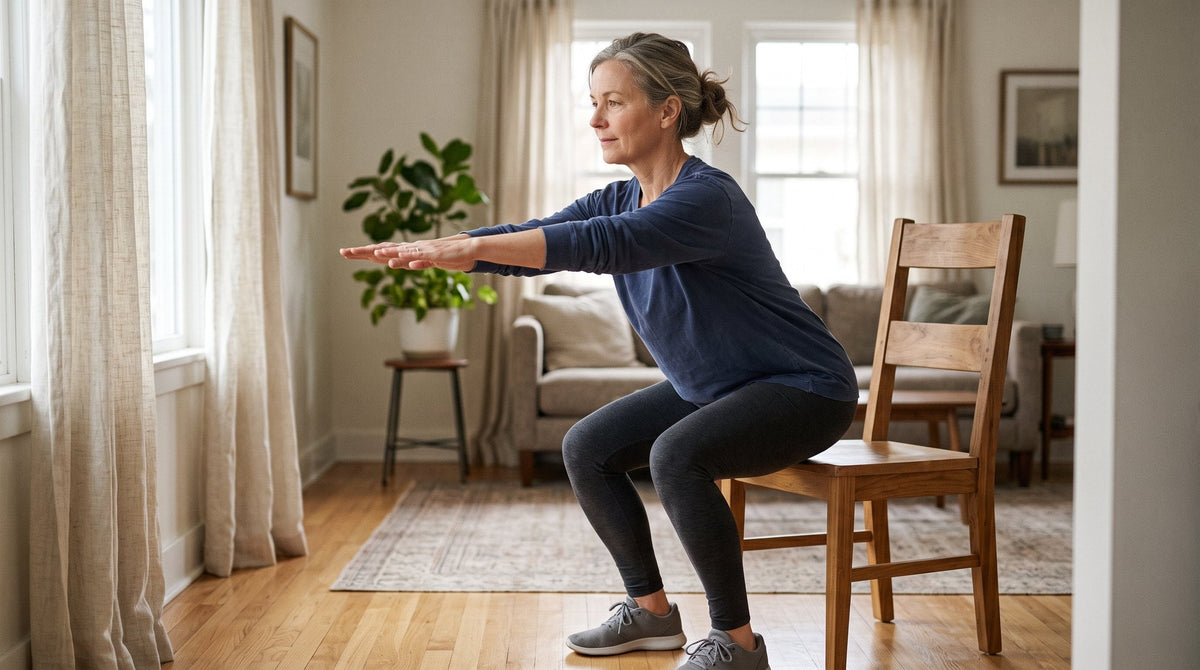
- Chair squat: Sit to a chair and stand back up, using your hands only if needed. 8–12 reps.
- Wall or counter push-up: Hands on a wall or kitchen counter, body in a straight line. 8–12 reps.
- One-arm dumbbell row: Rest one hand on a chair and pull a light dumbbell toward your hip. 8–12 reps per side.
- Glute bridge: Lie on your back, knees bent, and lift your hips. 10–12 reps.
- Seated dumbbell press: Press light dumbbells from shoulder height to overhead. 8–12 reps.
- Suitcase carry: Hold a dumbbell in one hand and walk tall for 20–30 seconds. Switch sides.
Choose a weight or version where the last two reps feel challenging but your form stays clean.
How to Progress Week by Week
| Weeks | Strength Sessions per Week | Sets per Exercise | Daily Walk |
|---|---|---|---|
| 1–2 | 2 | 1–2 | 10–15 minutes |
| 3–4 | 2 | 2 | 15–20 minutes |
| 5–6 | 3 | 2 | 20–25 minutes |
| 7–8 | 3 | 2–3 | 25–30 minutes |
When you can do one or two more reps than your target with good form, make the move a little harder. The ACSM suggests adding about 2–10% more load at that point. With dumbbells, that usually means the next size up. With bodyweight moves, try a harder version: a lower chair, a push-up on a lower surface or a single-leg bridge.
Add a Daily Walk
Walking is a partner to strength training, not a substitute. The advisory notes that aerobic activity alone does less for lean mass than strength work. It also recommends at least 150 minutes of moderate activity a week alongside strength training. A 25–30 minute walk on most days gets you there, and short walks after meals count.
Protein Basics: How Much You Need Each Day and at Each Meal
Strength training gives your muscles a reason to stay. Protein gives them the building material. The advisory points out that eating more protein is unlikely to be enough on its own without structured strength training.
- Per day: Targets of 1.2–1.6g of protein per kilogram of body weight have been proposed during active weight loss. A simpler option the advisory offers is a fixed goal of 80–120g a day. Formulas based on body weight can overestimate needs in larger bodies, so ask your care team or a registered dietitian for your number.
- Per meal: The International Society of Sports Nutrition suggests about 20–40g of protein per serving, spread every 3–4 hours. With a small appetite, 25–30g at each of three meals plus a protein-rich snack is a realistic way to reach your daily goal.
- If you're over 65: The PROT-AGE study group recommends at least 1.0–1.2g per kilogram a day, and 1.2g or more if you're active. People with severe kidney disease may need to limit protein, so check with your doctor first.
The advisory suggests a few habits for when you're rarely hungry:
- Eat the protein on your plate first.
- Lean on low-volume, protein-dense foods like Greek yogurt, cottage cheese, eggs, fish and nut butters.
- Try smaller, more frequent meals, and set a reminder to eat if you tend to forget.
As for timing around workouts, the ISSN notes that protein before or after training both work, so choose whichever sits better with you.
For meal ideas, see our guide to protein and lean mass on a GLP-1.
Recovery and Sleep Count Too
Muscles adapt between workouts. Keep these basics in place:
- Rest days: Leave at least one day between strength sessions.
- Some soreness is normal: Mild soreness a day or two after a new routine is common. Sharp pain or joint pain is a sign to stop and check in with your provider.
- Aim for 7–9 hours of sleep: That's the National Sleep Foundation's recommended range for adults. For adults over 65, it's 7–8 hours.
In a small, tightly controlled study, adults on a reduced-calorie diet lost 60% more fat-free mass when they slept 5.5 hours a night instead of 8.5 hours, and less of their weight loss came from fat. It was a two-week study of 10 people, but it's a good reason to guard your sleep. Read more about how sleep affects GLP-1 weight loss.
Track Strength and Waist, Not Just the Scale
A bathroom scale can't tell fat from muscle, so track these too:
- Your strength log: Write down the weight, sets and reps for each move. If those numbers climb over eight weeks, your muscles are responding.
- Your waist: Measure at the same spot and the same time of day every 2–4 weeks. A consensus statement calls waist size a vital sign because it adds information about health risk that weight and BMI miss.
- Everyday strength: Notice how stairs, grocery bags and getting up from a chair feel. The advisory lists simple sit-to-stand and stair-climb tests as useful strength checks, especially for older adults.
- Body composition: Ask your clinician whether a body composition scan, such as bioelectrical impedance or DXA, makes sense for you.
If your strength drops for a few weeks in a row, or you feel weak or dizzy, talk with your prescriber.
An Easy Option When Your Appetite Is Low
Food comes first. But on days when a full meal feels like too much, a light drink can be easier to get down. auravi made Preserve for those days. Each scoop of the tropical punch drink mix contains 5,000mg of essential amino acids, 3,000mg of creatine monohydrate and 1,500mg of HMB.
- Essential amino acids are the ones your body can't make. The ISSN notes they are the part of protein that drives muscle building.
- Creatine is one of the most studied sports nutrition ingredients and is linked to greater gains from training in an ISSN position stand.
- HMB is a compound made from the amino acid leucine that has been studied for exercise recovery.
Preserve helps maintain lean muscle while you lose weight and supports strength and performance alongside regular strength training.* It isn't a protein replacement, so keep building your meals around protein. Check with your prescriber before adding any supplement.
Frequently Asked Questions
Do I Need a Gym to Keep Muscle on a GLP-1 Medication?
No. Bodyweight moves, a resistance band and a couple of light dumbbells are enough for your first few months. What matters most is training two to three times a week and making it a little harder over time.
Am I Too Old to Start Strength Training?
Probably not. In the trial of dieting older adults described above, the resistance training group got about 19% stronger in six months. Start with the easiest version of each move and get your provider's okay first.
Is Some Muscle Loss Normal When Losing Weight?
Yes. Any large weight loss includes some lean mass, and the 2025 advisory notes that the losses seen with GLP-1 medications are similar to other approaches that produce large weight loss, such as bariatric surgery. The goal is to keep that share as low as you reasonably can with strength training, protein and sleep.
What If I Feel Too Tired or Queasy to Work Out?
Scale back instead of skipping. Do one set of each move, or take a short, easy walk. If fatigue or nausea sticks around, talk with your prescriber.
Sources
- Mozaffarian D et al. Nutritional priorities to support GLP-1 therapy for obesity: a joint Advisory from the American College of Lifestyle Medicine, the American Society for Nutrition, the Obesity Medicine Association, and The Obesity Society. Am J Clin Nutr. 2025.
- Look M et al. Body composition changes during weight reduction with tirzepatide in the SURMOUNT-1 study of adults with obesity or overweight. Diabetes Obes Metab. 2025.
- Karakasis P et al. Effect of glucagon-like peptide-1 receptor agonists and co-agonists on body composition: systematic review and network meta-analysis. Metabolism. 2024.
- Neeland IJ et al. Changes in lean body mass with glucagon-like peptide-1-based therapies and mitigation strategies. Diabetes Obes Metab. 2024.
- Villareal DT et al. Aerobic or resistance exercise, or both, in dieting obese older adults. N Engl J Med. 2017.
- American College of Sports Medicine. American College of Sports Medicine position stand: progression models in resistance training for healthy adults. Med Sci Sports Exerc. 2009.
- Jäger R et al. International Society of Sports Nutrition position stand: protein and exercise. J Int Soc Sports Nutr. 2017.
- Bauer J et al. Evidence-based recommendations for optimal dietary protein intake in older people: a position paper from the PROT-AGE Study Group. J Am Med Dir Assoc. 2013.
- Hirshkowitz M et al. National Sleep Foundation's sleep time duration recommendations: methodology and results summary. Sleep Health. 2015.
- Nedeltcheva AV et al. Insufficient sleep undermines dietary efforts to reduce adiposity. Ann Intern Med. 2010.
- Ross R et al. Waist circumference as a vital sign in clinical practice: a Consensus Statement from the IAS and ICCR Working Group on Visceral Obesity. Nat Rev Endocrinol. 2020.
- Kreider RB et al. International Society of Sports Nutrition position stand: safety and efficacy of creatine supplementation in exercise, sport, and medicine. J Int Soc Sports Nutr. 2017.
- Wilson JM et al. International Society of Sports Nutrition Position Stand: beta-hydroxy-beta-methylbutyrate (HMB). J Int Soc Sports Nutr. 2013.
This article is for educational purposes only and is not medical advice. Talk with your healthcare provider before changing your diet, exercise or supplement routine, especially while taking a GLP-1 medication. *These statements have not been evaluated by the Food and Drug Administration. This product is not intended to diagnose, treat, cure or prevent any disease.


