

Most adults need about 25g to 38g of fiber a day, or roughly 14g for every 1,000 calories they eat. Getting enough fiber on GLP-1 medications matters even more than usual. When your appetite shrinks, fiber usually shrinks with it, and constipation is one of the most common side effects of these medications.
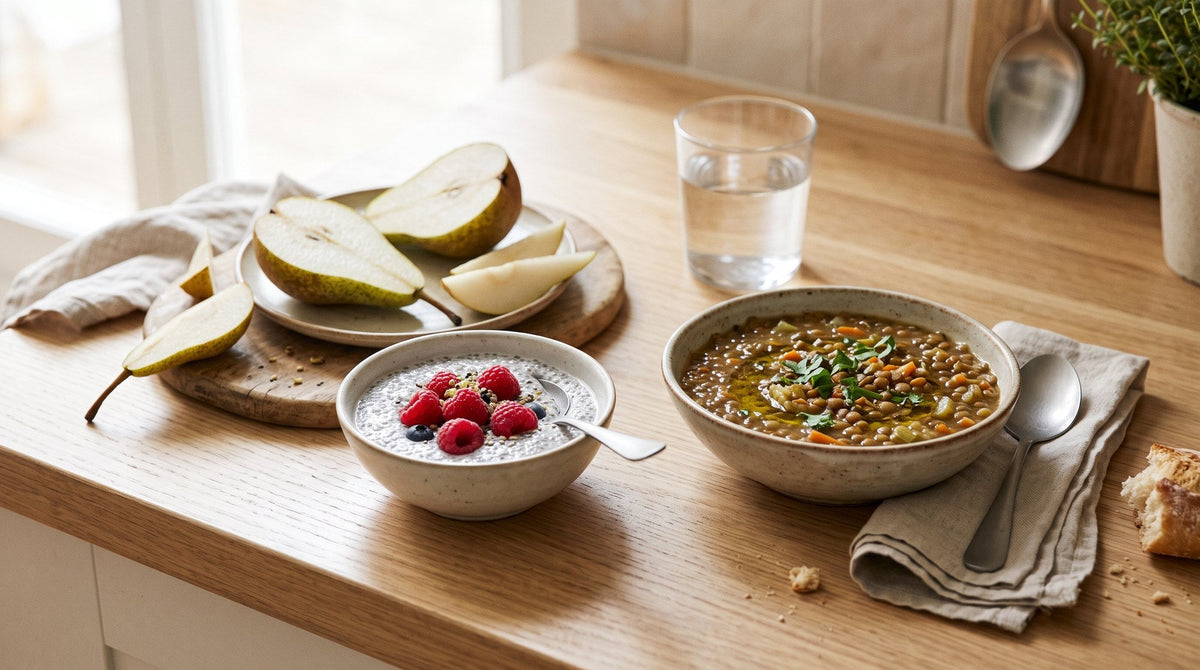
You don't need giant salads to close the gap. Small, fiber-dense foods like chia seeds, lentils, raspberries and beans pack a lot into a few bites. Add them slowly, drink more fluids and spread fiber across the day to keep bloating in check.
Why Fiber Matters on GLP-1 Medications
Why Fiber Intake Often Drops
GLP-1 medications turn down your appetite and slow how quickly food leaves your stomach (Mozaffarian et al., 2025). You feel full sooner, so portions get smaller, and fiber shrinks with them.
Fiber-rich foods also tend to be bulky. A big salad can feel like too much when you fill up after a few bites. And if you're focusing on protein to protect your lean mass, plant foods can get crowded off the plate.
Early research reflects this. In a U.S. study of 69 adults taking GLP-1 medications, average fiber intake from three-day food records was 14.5g a day (Johnson et al., 2025). In a 2026 study of 387 adults who logged two days of meals, it averaged about 7g (Korus et al., 2026). Both relied on self-reported diaries, but they point the same way. Fiber was already a gap for most Americans: more than 90% of women and 97% of men fall short (USDA and HHS, 2020).
The Link to Constipation
In the STEP 1 trial, about 23% of people taking semaglutide 2.4mg reported constipation, compared with about 10% on placebo (Wilding et al., 2021). In the SURMOUNT-1 trial, about 12% to 17% of people taking tirzepatide reported it, depending on the dose, compared with about 6% on placebo (Jastreboff et al., 2022).
A 2025 joint advisory from four nutrition and obesity medicine organizations says constipation should be managed proactively and encourages adequate fluids and fiber from foods. It also notes that extra steps are often needed (Mozaffarian et al., 2025). Our guide to managing constipation on GLP-1 covers other strategies.
How Much Fiber Do You Need?
The National Academies' Dietary Reference Intakes set an adequate intake of 14g of fiber for every 1,000 calories. For adults up to age 50, that works out to about 25g a day for women and 38g for men, with slightly lower targets after 50 (Institute of Medicine, 2005). The 2020–2025 Dietary Guidelines for Americans used the same benchmark (USDA and HHS, 2020).
Because the benchmark is tied to calories, it gives you a practical starting point if you're eating much less than before: about 17g a day at 1,200 calories, or about 21g at 1,500. That's simple math, not a prescription. A registered dietitian or your clinician can help you set a target that fits your plan.
Soluble vs. Insoluble Fiber, in Plain Words
Fiber is the part of plant foods your body can't digest. Most plant foods contain both main types.
- Soluble fiber mixes with water and forms a gel. You'll find it in oats, beans, lentils, chia seeds, many fruits and psyllium. Some of these gels hold water in the large intestine, which keeps stool softer and easier to pass (McRorie, 2015).
- Insoluble fiber doesn't dissolve. It adds bulk. Coarse pieces, like those in wheat bran, gently stimulate the bowel lining to release water and mucus, making stools bulkier, softer and quicker to move along (McRorie, 2015). Whole grains, nuts and many vegetables are good sources.
Gut bacteria also ferment many types of fiber. That feeds your microbes, but it produces gas, which is one reason a sudden jump in fiber can leave you bloated. For the bacteria side of gut health, see our article on probiotics for GLP-1 users.
You don't need to track the two types separately. The joint advisory suggests gradually adding foods with both, such as prunes or other dried fruits (Mozaffarian et al., 2025).
What the Research Says About Psyllium
Psyllium comes from the husks of plantago seeds, and it's one of the best-studied fibers for regularity. Gut bacteria don't break it down much, so it keeps its water-holding gel through the large intestine. That gel helps soften hard stools and firm up loose ones (McRorie, 2015).
- A 2022 meta-analysis of 16 randomized trials in 1,251 adults with chronic constipation found that 66% of people responded to fiber supplements, compared with 41% in control groups. Psyllium was one of the fibers with significant effects. Benefits were clearest above 10g a day for at least four weeks, and gas was more common with fiber (van der Schoot et al., 2022).
- A 2023 guideline from the American Gastroenterological Association and the American College of Gastroenterology suggests fiber supplements for adults with chronic constipation, points to psyllium as the fiber with supportive trial data and encourages adequate hydration with fiber. The panel rated the evidence as low certainty (Chang et al., 2023).
These studies involved people with chronic constipation, not GLP-1 users specifically, but they're a useful guide if you're considering a fiber supplement.
Where Gut Balance Fits
Food should do most of the work. If you'd like help filling the gap, Gut Balance provides 2,000mg of psyllium husk per scoop (1.6g of dietary fiber), plus 300mg of magnesium (as magnesium citrate), 125mg of ginger extract, a 150mg probiotic blend and a 50mg digestive enzyme blend. It's formulated to support regularity and healthy digestion.*
The studies above used more psyllium per day than one scoop provides, so count Gut Balance as one piece of your daily total alongside fiber-rich foods. Because psyllium soaks up water, mix each scoop with 12–16oz of water or another beverage, as the label directs, and keep sipping fluids through the day. If you have trouble swallowing, talk with your clinician before using any psyllium product (21 CFR 201.319). As with any new supplement, check with your prescriber first.
How to Add Fiber Without Extra Bloating
Adding a lot of fiber at once is a recipe for gas and cramping. These habits make the change easier:
- Go slowly. Add one fiber-rich food every few days. For fiber supplements, one expert review suggests starting at no more than 3–4g a day for the first week, then increasing gradually (McRorie, 2015).
- Drink more fluids. Fiber works better with plenty of liquid, according to the National Institute of Diabetes and Digestive and Kidney Diseases (NIDDK). Keep a water bottle within reach, and try these hydration hacks for GLP-1 users.
- Spread it across the day. A little fiber at each meal and snack is gentler than one big high-fiber meal. It also fits the smaller, more frequent meals the joint advisory suggests for easing nausea (Mozaffarian et al., 2025).
- Go easy when you start or increase a dose. Stomach side effects are more likely then. The advisory notes that during the first few days of treatment, smaller meals and avoiding fatty or high-fiber foods can ease symptoms (Mozaffarian et al., 2025). Once you feel settled, resume your slow build.
- If you're already backed up, check in first. Adding a lot of fiber when stool is already hard can cause cramping (McRorie, 2015). Ask your clinician how to get things moving before you ramp up.
High-Fiber Foods That Work With a Small Appetite
Soft, compact foods deliver fiber in a small volume, which helps when you fill up fast. Fiber values below come from USDA FoodData Central. Pick a few you enjoy.
| Food | Serving | Fiber |
|---|---|---|
| Chia seeds, dried | 1oz (28g) | 9.8g |
| Split peas, cooked | 1/2 cup (98g) | 8.1g |
| Raspberries, raw | 1 cup (123g) | 8.0g |
| Lentils, cooked | 1/2 cup (99g) | 7.8g |
| Black beans, cooked | 1/2 cup (86g) | 7.5g |
| Pear, raw | 1 medium (178g) | 5.5g |
| Avocado, raw | 1/2 cup cubed (75g) | 5.0g |
| Prunes (dried plums) | 5 prunes (48g) | 3.4g |
| Oats, dry (for oatmeal) | 1/3 cup (27g) | 2.7g |
| Flaxseed, ground | 1 tbsp (7g) | 1.9g |
Easy ways to use them:
- Stir ground flaxseed into yogurt, or soak chia seeds in milk overnight for chia pudding.
- Freeze lentil or split pea soup in small portions.
- Keep prunes or a pear on hand for snacks.
A half cup of lentils at lunch, a cup of raspberries as a snack and 1 tbsp of ground flaxseed in your morning yogurt come to about 17.7g, right around the 1,200-calorie starting point above.
When to Call Your Clinician
Constipation is common on GLP-1 medications, but some symptoms need prompt attention. The joint advisory encourages contacting your clinician early when side effects develop (Mozaffarian et al., 2025). Call right away if you're constipated and have any of these:
- No bowel movement for several days, along with belly pain
- Vomiting
- Severe bloating
- Constant pain in your abdomen
- Being unable to pass gas
- Blood in your stool or bleeding from your rectum
- Fever
Most of these come from NIDDK's list of constipation symptoms that need a doctor right away (NIDDK). Also reach out if constipation hangs on despite more fiber and fluids, or before you start using laxatives regularly.
Frequently Asked Questions
Can Fiber Make Bloating Worse on a GLP-1 Medication?
It can if you add too much too fast. Gut bacteria ferment many fibers, which produces gas, and fiber supplement trials report more gas than control treatments (van der Schoot et al., 2022).
Is It Better to Get Fiber From Food or a Supplement?
Start with food. Fiber-rich foods bring vitamins, minerals and other nutrients along with the fiber. A psyllium supplement can help fill the gap on low-appetite days, as long as you take it with plenty of fluid.
How Long Does It Take for More Fiber to Help With Regularity?
Give it some time. In the 2022 meta-analysis, improvements in bowel movement frequency were clearest in trials lasting at least four weeks (van der Schoot et al., 2022). If you're uncomfortable in the meantime, check in with your clinician.
Do I Need to Count Fiber Grams Every Day?
Not forever. Tracking for a few days shows you where you stand. After that, a simple habit, like one fiber-rich food at every meal and snack, can keep you on track without the math.
Sources
- Wilding JPH, et al. Once-Weekly Semaglutide in Adults with Overweight or Obesity. N Engl J Med. 2021. https://pubmed.ncbi.nlm.nih.gov/33567185/
- Jastreboff AM, et al. Tirzepatide Once Weekly for the Treatment of Obesity. N Engl J Med. 2022. https://pubmed.ncbi.nlm.nih.gov/35658024/
- Mozaffarian D, et al. Nutritional Priorities to Support GLP-1 Therapy for Obesity: A Joint Advisory from the American College of Lifestyle Medicine, the American Society for Nutrition, the Obesity Medicine Association, and The Obesity Society. Am J Clin Nutr. 2025. https://pubmed.ncbi.nlm.nih.gov/40450457/
- Johnson B, et al. Investigating Nutrient Intake During Use of Glucagon-Like Peptide-1 Receptor Agonist: A Cross-Sectional Study. Front Nutr. 2025. https://pubmed.ncbi.nlm.nih.gov/40352260/
- Korus S, et al. Dietary Intake Patterns and Nutritional Adequacy Among Adults with Overweight or Obesity Treated with GLP-1 or Dual GIP/GLP-1 Receptor Agonists: Preliminary Study. J Transl Med. 2026. https://pubmed.ncbi.nlm.nih.gov/41965670/
- U.S. Department of Agriculture and U.S. Department of Health and Human Services. Dietary Guidelines for Americans, 2020–2025. 9th Edition. 2020. https://www.dietaryguidelines.gov/sites/default/files/2020-12/Dietary_Guidelines_for_Americans_2020-2025.pdf
- Institute of Medicine. Dietary Reference Intakes for Energy, Carbohydrate, Fiber, Fat, Fatty Acids, Cholesterol, Protein, and Amino Acids. National Academies Press. 2005. https://doi.org/10.17226/10490
- McRorie JW Jr. Evidence-Based Approach to Fiber Supplements and Clinically Meaningful Health Benefits, Part 2: What to Look for and How to Recommend an Effective Fiber Therapy. Nutr Today. 2015. https://pubmed.ncbi.nlm.nih.gov/25972619/
- van der Schoot A, et al. The Effect of Fiber Supplementation on Chronic Constipation in Adults: An Updated Systematic Review and Meta-Analysis of Randomized Controlled Trials. Am J Clin Nutr. 2022. https://pubmed.ncbi.nlm.nih.gov/35816465/
- Chang L, et al. American Gastroenterological Association–American College of Gastroenterology Clinical Practice Guideline: Pharmacological Management of Chronic Idiopathic Constipation. Gastroenterology. 2023. https://pubmed.ncbi.nlm.nih.gov/37211380/
- National Institute of Diabetes and Digestive and Kidney Diseases. Eating, Diet, & Nutrition for Constipation. 2018. https://www.niddk.nih.gov/health-information/digestive-diseases/constipation/eating-diet-nutrition
- National Institute of Diabetes and Digestive and Kidney Diseases. Symptoms & Causes of Constipation. 2018. https://www.niddk.nih.gov/health-information/digestive-diseases/constipation/symptoms-causes
- U.S. Department of Agriculture, Agricultural Research Service. FoodData Central: SR Legacy. 2018. https://fdc.nal.usda.gov/
- U.S. Food and Drug Administration. 21 CFR 201.319: Required Warnings and Labeling for Water-Soluble Gums, Hydrophilic Gums and Hydrophilic Mucilloids (Including Psyllium). Code of Federal Regulations. https://www.ecfr.gov/current/title-21/chapter-I/subchapter-C/part-201/subpart-G/section-201.319
This article is for educational purposes only and is not medical advice. Talk with your healthcare provider before changing your diet, exercise or supplement routine, especially while taking a GLP-1 medication. *These statements have not been evaluated by the Food and Drug Administration. This product is not intended to diagnose, treat, cure or prevent any disease.


