

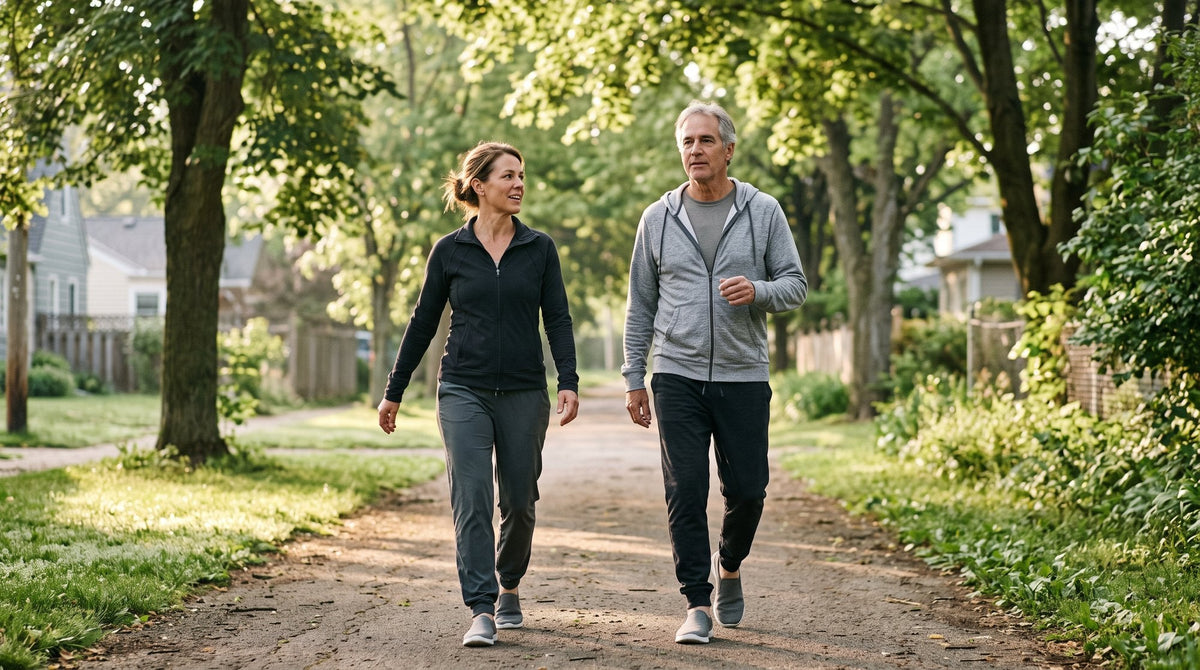
The 6-6-6 walking challenge is a social media trend: a 60-minute walk at 6 a.m. or 6 p.m., with a 6-minute warm-up before and a 6-minute cool-down after. It is not a clinical program, and no study has tested it as a package. But its core habit, regular brisk walking, is one of the best-supported things you can do for your health.
If you take a GLP-1 medication, think of the full hour as a goal, not a starting point. Begin with shorter walks, build up over several weeks, eat and drink something around your walks, and add strength training to help hold on to muscle while you lose weight.
The trend is often aimed at women, but nothing about it is sex-specific. Regular activity benefits adults regardless of age, sex or body size, according to the Physical Activity Guidelines for Americans.
What Is the 6-6-6 Walking Challenge?
As it's usually described online, the challenge has three parts:
- A 6-minute warm-up: an easy stroll, leg swings or arm circles.
- A 60-minute walk: brisk but conversational.
- A 6-minute cool-down: slower walking and a few gentle stretches.
The 6 a.m. or 6 p.m. start is mostly about routine. Some versions add "six days a week," others "six weeks." None of these details come from research, so shape them to fit your life.
For scale, about 100 steps per minute marks moderate intensity for adults aged 21 to 85, according to the CADENCE-Adults study. At that pace, a 60-minute walk adds roughly 6,000 steps.
What the Research Says About Walking
The Guidelines
The Physical Activity Guidelines ask adults to get 150 to 300 minutes of moderate-intensity aerobic activity a week, plus muscle-strengthening activity on 2 or more days. Walking briskly, at 2.5 to 4 miles per hour, counts as moderate. The least active people benefit most from even modest increases, activity of any length counts, and small, gradual increases help your body adapt while keeping injury risk low.
A daily 60-minute walk adds up to 420 minutes a week, above the guideline range. More activity brings extra benefits, but you don't need the full challenge to get meaningful ones. About 22 minutes a day reaches 150 minutes a week.
Step Counts and Longevity
A 2022 meta-analysis of 15 cohorts followed about 47,000 adults for a median of seven years. The more steps people took each day, the lower their risk of dying during follow-up. The most active group (about 10,900 steps a day) had roughly half the risk of the least active group (about 3,550). The benefit leveled off at around 6,000 to 8,000 steps a day for adults 60 and older, and 8,000 to 10,000 for younger adults. These are observational findings, so they show a link, not cause and effect.
Short Walks After Meals
Timing may matter for blood sugar. In a meta-analysis of seven one-day crossover trials, mostly in adults with overweight or obesity, breaking up long sitting with frequent short, light walks lowered blood sugar and insulin after meals compared with sitting straight through. Standing breaks helped less. In a randomized crossover study of 41 adults with type 2 diabetes, walking 10 minutes after each main meal lowered post-meal blood sugar by about 12% compared with one 30-minute walk a day, with the biggest difference after dinner.
None of these studies involved GLP-1 medications. Still, they suggest short walks after meals are a reasonable alternative to one long walk.
How to Adapt the Challenge on a GLP-1 Medication
GLP-1 medications turn down your appetite, so you may be eating far less than before. Fatigue and dizziness are also listed side effects. In the weight-loss trials, dizziness was reported by 8% of people taking semaglutide 2.4mg versus 4% on placebo, and by 4–5% of people taking tirzepatide versus 2% on placebo. Fatigue was also more common. The 2025 joint advisory on nutrition and GLP-1 therapy says exercise plans should match each person's fitness level and physical capacity.
Start Shorter and Build Up
Begin with a length that feels easy, even if that's 10 minutes. Move up only when your current walk has felt comfortable for about a week. One sample plan:
| Weeks | Walking Time per Day (Plus Warm-Up and Cool-Down) |
|---|---|
| 1–2 | 10–15 minutes |
| 3–4 | 20–25 minutes |
| 5–6 | 30–40 minutes |
| 7 and beyond | 45–60 minutes, in one walk or two |
The advisory notes that nausea and food aversions tend to show up when people start treatment or increase a dose, so drop back a step during those weeks if you need to. A 30-minute walk at 6 a.m. plus another at 6 p.m. counts just as well as one long walk. For pace, use the talk test from the Physical Activity Guidelines: at moderate intensity you can talk but not sing.
Eat a Little Something First
A low appetite can mean going hours without eating, which the advisory notes can leave some people short on nutrients. For nausea, it suggests a small breakfast, then small meals every 3–4 hours with enough fluids, and notes that vomiting is more likely after large meals. For walkers, that means:
- Before a 6 a.m. walk, have a glass of water and a few bites of protein, such as Greek yogurt, a hard-boiled egg or a cheese stick.
- Skip big meals right before a brisk walk. If a full stomach makes you queasy, take an easy 10-minute stroll after eating instead, which may also help with bloating and gas on a GLP-1.
- Afterward, have a meal or snack with protein when you can.
Fluids, Electrolytes and Hot Weather
Nausea, vomiting and diarrhea can all cause fluid loss. The prescribing information for both semaglutide and tirzepatide tells patients to drink fluids to reduce the chance of dehydration, which in some cases has led to kidney problems. A long walk adds sweat losses on top of that.
The American College of Sports Medicine (ACSM) advises starting activity well hydrated and drinking enough to avoid losing more than 2% of your body weight as fluid. Sweat rates vary a lot, and weighing yourself before and after a walk shows roughly how much you lost. It also helps to know the signs of dehydration on a GLP-1.
Walking in the Heat
The ACSM notes that people who are dehydrated, not used to the heat, recently ill or taking certain medications are more prone to exhaustion in hot conditions, and that fatigue sets in faster as heat stress rises. On hot days:
- Choose the 6 a.m. slot, a shaded route or an indoor option like a treadmill or mall.
- Shorten the walk and slow your pace.
- If you feel dizzy, nauseated, crampy or unusually tired, stop, get somewhere cool and drink.
- Confusion or fainting in the heat is an emergency. Call 911 and start cooling the person right away.
Where an Electrolyte Drink Fits
Water is the default. The ACSM notes that drinks with electrolytes can offer benefits over water alone in certain circumstances, and longer or hotter walks are the likeliest time. For those days, auravi Hydrate has 300mg of sodium and 150mg of potassium per scoop, with 5 calories. It supports hydration and electrolyte balance on longer or hot-weather walks.* It adds to your daily water rather than replacing it. If you've been told to limit sodium or potassium, check with your clinician first.
Why Walking Needs a Strength Partner
Walking supports your heart and blood sugar, but it does less for muscle. When you lose weight, some of what you lose is lean mass, and the 2025 advisory notes that aerobic activity alone has a smaller effect on preserving it. For people taking GLP-1 medications, it recommends strength training at least 3 times a week plus at least 150 minutes of moderate aerobic exercise.
A trial of 160 older adults with obesity shows why. The exercise groups all lost about 9% of their body weight. People who did only aerobic exercise lost 5% of their lean mass; those who did resistance training, alone or with aerobic exercise, lost 2–3%. The combined group also gained the most physical function.
You don't need a gym. Our beginner's guide to preventing muscle loss on a GLP-1 has a simple eight-week strength routine and protein targets for a smaller appetite. On strength days, a shorter walk is fine.
Safety Notes: Dizziness, Joint Pain and Your Clinician
Most healthy adults can start walking without a medical visit, according to the Physical Activity Guidelines, but people with chronic conditions benefit from guidance. Talk with your prescriber before building toward an hour a day if you have heart, lung or kidney disease, take insulin, a sulfonylurea or blood pressure medicine, or have fainted before.
If You Feel Dizzy
Low blood pressure affected under 2% of people on either medication in the trials. It was more common in people also taking blood pressure medicine and sometimes came with stomach side effects and dehydration. If you take insulin or a sulfonylurea, a GLP-1 medication can raise your risk of low blood sugar, and exercise can add to it. The American Diabetes Association advises adjusting carbohydrates or medication with your care team and checking your glucose more often while you do.
If you feel lightheaded, stop and sit down, drink something, and eat a little if you think your blood sugar is low. Stand up slowly. If it keeps happening, tell your prescriber. Fainting or chest pain needs medical care right away.
If Your Joints Hurt
The American College of Rheumatology strongly recommends exercise for knee, hip and hand osteoarthritis. Walking is the most studied form, though no single type has proved best, and water exercise is another option. The guideline notes there is no agreed level of pain at which you should or shouldn't exercise. Try flatter routes, shorter split walks and supportive shoes, and get checked for sharp pain, swelling or pain that changes how you walk.
Frequently Asked Questions
Is the 6-6-6 Walking Challenge Safe on a GLP-1 Medication?
Physical activity is safe for almost everyone, and the challenge can work on a GLP-1 medication if you build up gradually, eat and drink beforehand, and stop if you feel dizzy or unwell. Check with your prescriber first if you have a chronic condition.
Do I Have to Walk at 6 a.m. or 6 p.m.?
No. The times are part of the trend's branding, not something research has tested. Pick a time you can repeat. In hot weather, early morning is usually cooler.
Can I Split the 60 Minutes Into Shorter Walks?
Yes. The Physical Activity Guidelines say activity of any length counts toward your weekly total. Two 30-minute walks, or a few short walks after meals, both work, and the after-meal walks may help with blood sugar.
Sources
- Piercy KL et al. The Physical Activity Guidelines for Americans. JAMA. 2018.
- Tudor-Locke C et al. Walking cadence (steps/min) and intensity in 61–85-year-old adults: the CADENCE-Adults study. Int J Behav Nutr Phys Act. 2021.
- Paluch AE et al. Daily steps and all-cause mortality: a meta-analysis of 15 international cohorts. Lancet Public Health. 2022.
- Buffey AJ et al. The acute effects of interrupting prolonged sitting time in adults with standing and light-intensity walking on biomarkers of cardiometabolic health in adults: a systematic review and meta-analysis. Sports Med. 2022.
- Reynolds AN et al. Advice to walk after meals is more effective for lowering postprandial glycaemia in type 2 diabetes mellitus than advice that does not specify timing: a randomised crossover study. Diabetologia. 2016.
- Novo Nordisk. Semaglutide injection 2.4mg: full prescribing information (revised 06/2026). DailyMed, U.S. National Library of Medicine. DailyMed
- Eli Lilly and Company. Tirzepatide injection for weight reduction: full prescribing information (revised 08/2026). DailyMed, U.S. National Library of Medicine. DailyMed
- Mozaffarian D et al. Nutritional priorities to support GLP-1 therapy for obesity: a joint Advisory from the American College of Lifestyle Medicine, the American Society for Nutrition, the Obesity Medicine Association, and The Obesity Society. Am J Clin Nutr. 2025.
- American College of Sports Medicine; Sawka MN et al. American College of Sports Medicine position stand: exercise and fluid replacement. Med Sci Sports Exerc. 2007.
- American College of Sports Medicine; Armstrong LE et al. American College of Sports Medicine position stand: exertional heat illness during training and competition. Med Sci Sports Exerc. 2007.
- Villareal DT et al. Aerobic or resistance exercise, or both, in dieting obese older adults. N Engl J Med. 2017.
- Colberg SR et al. Physical activity/exercise and diabetes: a position statement of the American Diabetes Association. Diabetes Care. 2016.
- Kolasinski SL et al. 2019 American College of Rheumatology/Arthritis Foundation guideline for the management of osteoarthritis of the hand, hip, and knee. Arthritis Care Res (Hoboken). 2020.
This article is for educational purposes only and is not medical advice. Talk with your healthcare provider before changing your diet, exercise or supplement routine, especially while taking a GLP-1 medication. *These statements have not been evaluated by the Food and Drug Administration. This product is not intended to diagnose, treat, cure or prevent any disease.


